DKW2
DKW cars were made from 1928 until 1968, apart from the interruption caused by the Second World War. DKWs always used two-stroke engines, reflecting the company's position by the end of the 1920s as the world's largest producer of motorcycles. The first DKW car, the small and rather crude Typ P, emerged on 7 May 1928 and the model continued to be built at the company's Spandau (Berlin) plant, first as a roadster and later as a stylish if basic sports car, until 1931.
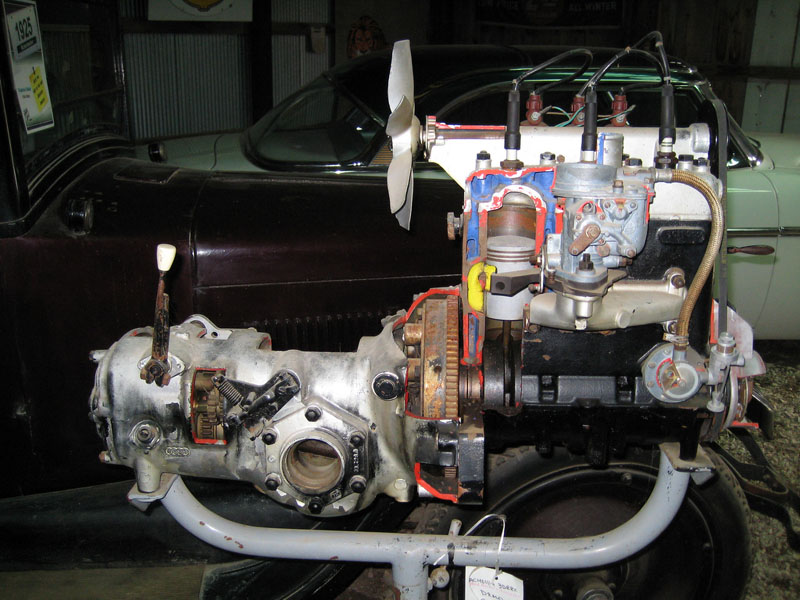
More significant was a series of inexpensive cars built 300 km (185 miles) to the south in Zwickau in the plant acquired by the company's owner Jørgen Skafte Rasmussen in 1928 when he had become the majority owner in Audi Werke AG. Models F1 to F8 (F for Front) were built between 1931 and 1942, with successor models reappearing after the end of the war in 1945. They were the first volume production cars in Europe with front wheel drive, and were powered by transversely mounted two-cylinder two-stroke engines. Displacement was 584 or 692 cc: claimed maximum power was initially 15 PS, and from 1931 a choice between 18 or 20 hp (15 kW). These models had a generator that doubled as a starter, mounted directly on the crankshaft, known as a Dynastart. DKW in Zwickau produced approximately 218,000 units between 1931 and 1942. Most of those cars were sold on the home market and over 85% of DKWs produced in the 1930s were the little F series cars: DKW reached second place in German sales by 1934 and stayed there, accounting for 189,369 of the cars sold between 1931 and 1938.
Between 1929 and 1940, DKW produced a less well remembered but technically intriguing series of rear-wheel drive cars called (among other names) Schwebeklasse and Sonderklasse with two-stroke V4 engines.[11] Engine displacement was 1,000 cc, later 1,100 cc. The engines had two extra cylinders that acted as air compressors for forced induction, so they had the external appearance of a V6 engine but without spark plugs on the front cylinder pair.
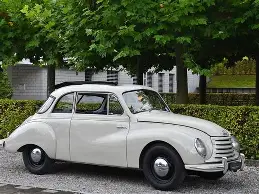
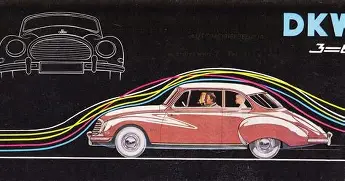
In 1939, DKW made a prototype with the first three-cylinder engine, with a displacement of 900 cc and producing 30 hp (22 kW). With a streamlined body, the car could run at 115 km/h (71 mph). It was put into production after World War II, first as an Industrieverband Fahrzeugbau (IFA)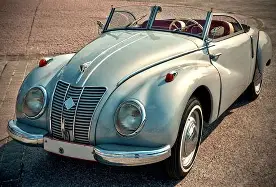 F9 (later AWZ P70) in Zwickau, East Germany, and shortly afterwards in DKW-form from Düsseldorf as the 3=6 or F91.